
Miami County Court Records After Arrest
After a Miami County arrest, the custody record and the court record split. The jail books the person and handles local custody. The Miami County Attorney decides which Kansas-law charges to prosecute for adults and juveniles, and those charges proceed through District Court of Miami County, Kansas. The current county attorney named in the research is Kenton Harding. The office also represents the State of Kansas in Osawatomie State Hospital commitment proceedings and child abuse or neglect matters, but the criminal charge path for a jail arrest runs through District Court.
The arrest side is not the same as court records after arrest. Jail custody, booking status, and records requests belong with Miami County jail inmate records. Booking photos have their own limits and request path on the Miami County jail mugshots page. Court records after a jail arrest focus on the filed complaint, information, indictment, docket events, bond orders, hearing dates, attorneys, prosecutor entries, and final case results.
For court-specific information, start with Kansas Case Search and the Miami County District Court docket route. If a case is too new, recently continued, sealed, or not available online, the courthouse or clerk route may be needed.
Find Miami County Court Records After Arrest
Kansas provides statewide district court record access through Kansas Case Search. Official guidance says searches may use case number, party name, business name, citation, or other role-specific criteria. The research could not inspect every form field because direct access was limited by bot protection, so the page should not be treated as proof that every field is available to every user in every case.
- Open Kansas Case Search or the Kansas Judicial Branch District Court Records guidance page.
- Search by the defendant's name, case number, business name, citation, or another available official criterion.
- Open the case result and compare the case caption, party role, and court location before relying on it.
- Read each charge, event, hearing date, bond entry, and disposition separately because one case can have more than one charge status.
The Miami County District Court page also provides docket-by-date PDFs. It says parties searching for specific cases can search the dockets by entering the last name of the party, but the calendars are for reference only. Recent hearings, continuances, bond changes, and clerk updates can change the official record after a calendar PDF is posted.
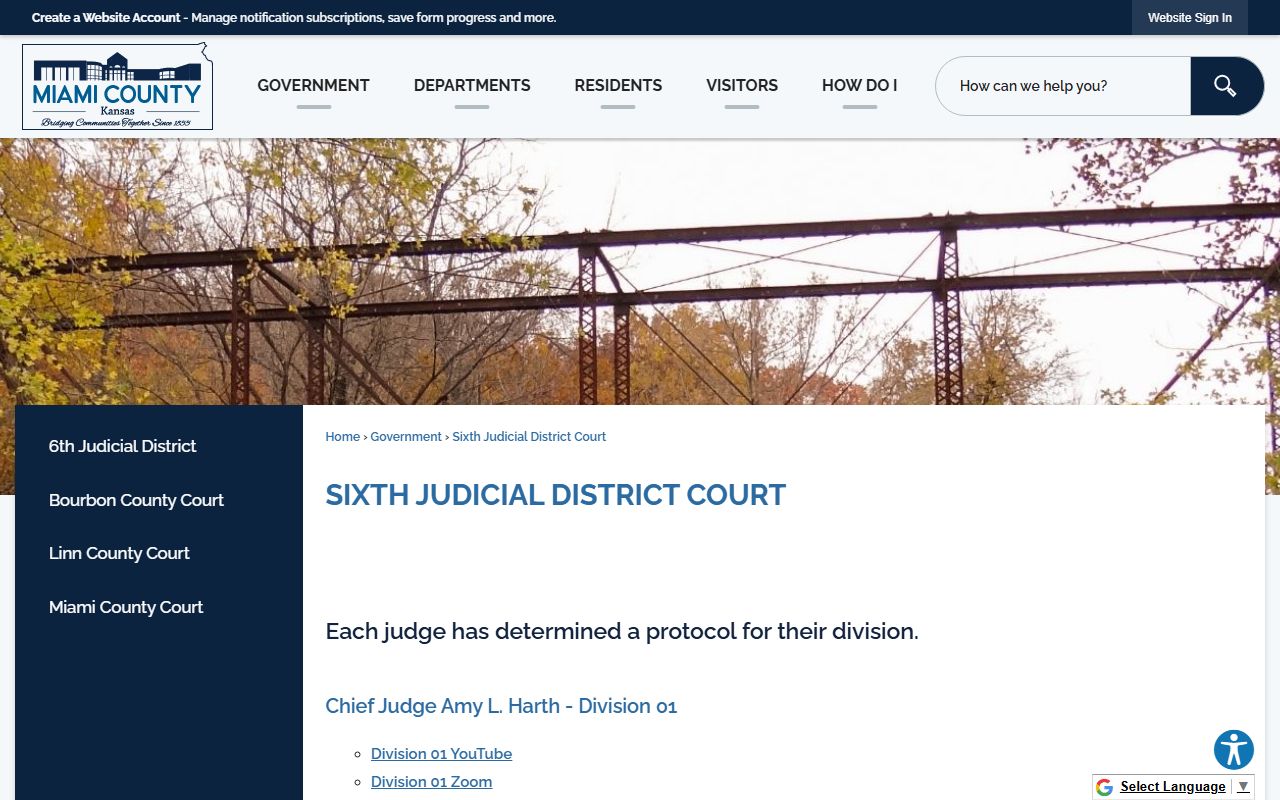
The screenshot below comes from the county's Sixth Judicial District Court page. The source page is useful because it ties local docket access to the Miami County courthouse route.
Charges Filed After Miami County Arrest
Charges can change after booking. A jail entry may use the arresting officer's initial allegation or a warrant label. The prosecutor can file, amend, reduce, dismiss, or add charges as the case develops. Court records after a jail arrest should therefore be checked by formal filing and current docket status rather than by the first booking label alone.
| Document | Who Uses It | What It Means |
|---|---|---|
| Complaint | Common prosecutor filing | Starts or states criminal allegations in court based on probable cause. |
| Information | Prosecutor filing | Lists formal charges, often after review or preliminary proceedings. |
| Indictment | Grand jury route | Charges returned through a grand jury process when that process is used. |
Miami County Charge Status Terms
A single Miami County court record can contain several charges with different results. One count may be amended while another is dismissed. A bond hearing may happen before a final plea or trial. Read the docket event and the charge status together, then verify unclear terms with the court or an attorney.
| Status | Meaning in a Court Record |
|---|---|
| Pending | The charge is still active and has not reached final disposition. |
| Amended or Reduced | The filed charge changed, often by prosecutor action, plea agreement, or court order. |
| Dismissed | The charge was ended by court order or prosecutor action, but the record may still show the filing history. |
| Nolle Prosequi | A prosecutor has declined to proceed on that charge in that case context. |
| Convicted | The charge ended in a guilty plea, finding, or verdict. |
Bond Events After Miami County Arrest
Miami County did not publish a dedicated online bond-posting page in the official sources located. Bond amount and release eligibility should be confirmed directly with Miami County Jail or through the court case. The sheriff fee schedule does list bond receipt copies for $5.00, which shows that bond receipt records are maintained and may be requested after payment or release.
| Bond Type | How It Works |
|---|---|
| Cash bond | Money is paid directly to meet the court's release condition. |
| Surety bond | A licensed bonding company posts bond for the defendant under its contract terms. |
| PR or own recognizance | The person is released on a written promise and court conditions rather than full payment. |
| No-bond hold | Release is blocked until further court or agency action. |
| Other agency hold | A warrant, probation or parole hold, ICE detainer, or out-of-county matter may keep the person in custody. |
Do not apply the sheriff's records-payment rule to live bond posting unless the jail confirms it. The research states that records fees are cash or money order only and that credit or debit cards are not accepted for records. Bond payment details were not published in the located jail pages.
Warrants and Miami County Arrest Records
No official Miami County online active-warrant search page was located. The sheriff divisions page says Road Patrol handles calls for service, including civil process, executions, and warrants. If a warrant caused the jail arrest, the public path is to call the sheriff's office, check court dockets or Kansas Case Search when the warrant is tied to a court case, and contact the issuing municipal or law-enforcement agency for city matters.
Warrant terms can be easy to mix up. An arrest warrant begins custody after a judge authorizes arrest. A bench warrant usually follows missed court or failure to obey an order. A search warrant allows a search, not custody by itself. A fugitive or out-of-county warrant can create a hold after local booking. A warrant-related jail entry does not prove conviction.
Note: City bench warrants may not appear on a county sheriff web page, so the issuing court or agency may be the only reliable source.
Charges vs Convictions
An arrest is an event. A charge is an accusation filed or pursued in court. A conviction is a final result from a plea, verdict, or finding. Miami County court records after a jail arrest can show all three stages, but the stages do not mean the same thing and should not be used as if they do.
| Point | Charge | Conviction |
|---|---|---|
| Legal role | Accusation brought in court | Final finding or plea outcome |
| Timing | Usually early in the case | After plea, trial, or disposition |
| Can change | Yes, it may be amended, reduced, added, or dismissed | May be appealed, set aside, or later expunged if eligible |
| How to verify | Check docket and filings | Check final disposition and judgment entries |
Sealed and Expunged Court Records
Kansas public-record rules allow some information to be closed, redacted, or restricted. Juvenile records, sealed materials, records tied to active investigations, and some dismissed or expunged matters may not be publicly viewable in the same way as an ordinary adult criminal docket. K.S.A. 45-221 lists records not required to be disclosed and supports separation of open and closed information.
| Issue | Sealed | Expunged |
|---|---|---|
| Public view | Hidden or limited by court order | Removed from ordinary public access if granted under applicable law |
| Record status | Still exists with restricted access | Treated differently by law after the expungement order |
| Who decides | Court or statute-based access rule | Court order after eligibility and filing process |
| Where to ask | Clerk or court handling the case | Clerk, attorney, or court handling expungement |
KBI History vs Court Case
A Miami County court case search is not the same as a complete statewide criminal history. The KASPER disclaimer itself says KASPER is not a complete criminal history and directs users to Kansas criminal history record checks for that purpose. For statewide Kansas criminal history, use the official Kansas criminal history record search route rather than trying to combine jail, court, and corrections pages by hand.
Important: Do not use casual inmate, court, or custody lookups for employment, tenant, credit, insurance, or other FCRA-covered screening.
Restricted Records After Arrest
Sheriff and court records may be public in part and closed in part. The Sheriff's Records page says information from cases still under investigation cannot be released. Kansas open-records law also allows agencies to withhold or redact certain records. For court records after a jail arrest, the most common access limits involve juvenile cases, sealed orders, expunged matters, active investigations, protected victim information, and records that have not yet been entered or updated.
Older documents or non-online filings may require the Miami County Courthouse route. The courthouse address in the research is District Court, 120 S. Pearl, Paola, KS 66071, phone 913-294-3326, with hours listed as 8 a.m. to 4 p.m. The County Attorney's Office is in the courthouse at 120 S. Pearl, Room 300, Paola, KS 66071, phone 913-294-3181, and hours Monday through Friday, 8 a.m. to 4:30 p.m.